 EmploiAlign™
Federal Displacement · How-to Guide
How Federal Professionals Can Navigate Private-Sector ATS
Your federal career was real. The gap between it and a private-sector job offer isn't substance — it's translation.
You spent 15, 20 years building real expertise inside a federal agency. You managed programs worth hundreds of millions of dollars. You led teams through agency-wide transformation, absorbed reorganizations, and delivered under a level of scrutiny most private-sector managers never face. You did the work, and you did it well.
Then you sent your resume to three private-sector companies — and heard nothing back. No interview. No recruiter call. Not even a rejection you could learn from. Just silence.
Here's what that silence usually means, and it's not what you think: this isn't a writing problem. It's a translation problem. And right now it's happening to roughly 330,000 federal professionals in transition to the private sector at the same time.
I've spent more than 20 years working across federal technology strategy and enterprise AI modernization, and I've sat on both sides of the hiring table. That vantage point makes one pattern impossible to miss: the exact point where a genuinely strong federal career becomes invisible to a private-sector applicant tracking system. The people this happens to are not weak candidates. They are strong candidates whose strength never makes it through the filter.
Why can't the ATS read a federal career?
An applicant tracking system — and the hiring panel reading behind it — is scanning for signals it recognizes. A federal career is full of signals too, but they're written in a different language. Three mismatches do most of the damage:
- GS-15 does not translate to VP. Grade levels are a federal-only signal. A private-sector ATS and the panel behind it are scanning for seniority language they already recognize — director, vice president, head of. "GS-15" carries enormous weight inside government and almost none outside it, so the system simply doesn't score it.
- Program Management Office does not translate to P&L ownership. Even when the scope and complexity are identical, the vocabulary doesn't map. A commercial reader scores for budget owned, revenue influenced, and outcomes delivered — so a resume built on federal program language scores low on both keyword and seniority match, no matter how large the program was.
- Compliance-driven language reads as passive. Federal writing rewards process, procedure, and adherence to mandate. Private-sector panels are scoring for owned outcomes and quantified impact. When every bullet describes a process you supported rather than a result you drove, a strong record can read as administrative.
The translation framework
The fix isn't a nicer template or a different font. It's re-translating the scope of what you did into language a commercial hiring panel already scores against. Four steps do the heavy lifting:
- Step 1 — Map your title to the band it actually matches. Translate your federal title and grade to the private-sector seniority band it truly corresponds to — not what it sounds like, and not an inflated guess. This is the anchor everything else hangs on.
- Step 2 — Re-express scope in commercial terms. Restate program and budget scope the way a business reader measures it: budget size, headcount managed, number of stakeholders, and the delivery outcomes you were accountable for.
- Step 3 — Convert compliance-voice bullets into outcome-owned bullets. Rewrite each line to say what changed, by how much, and because of you. Trade "responsible for ensuring compliance with…" for "cut X by Y% across Z sites."
- Step 4 — Mirror the language of the specific job description. Match the exact keyword language of the private-sector JD in front of you, not generic federal terminology. Every posting scores against its own words; give it back the words it's looking for.
Isn't this just "dumbing down" a serious career?
No — it's the opposite. Translation isn't simplification, and it isn't embellishment. You are not adding anything that wasn't there; you are making real scope legible to a reader who doesn't share your vocabulary. A program you actually ran is a program you can describe in commercial terms honestly. The goal is to stop a strong record from being penalized for the accident of where it was earned.
Guidance
- Don't just reformat your federal resume — re-translate the scope of what you did into language a commercial hiring panel already scores against.
- Treat every silence after applying as a translation signal, not a rejection of your career. The silence is telling you the system couldn't read your value, not that the value isn't there.
How EmploiAlign helps
EmploiAlign was built for exactly this translation gap. It doesn't rewrite your career — it makes your real career readable. Here's how that works, step by step:
- AlignProfile™ ingests your federal resume, performance reviews, or bio and builds one structured profile — pulling out the achievements that matter, not just the job history.
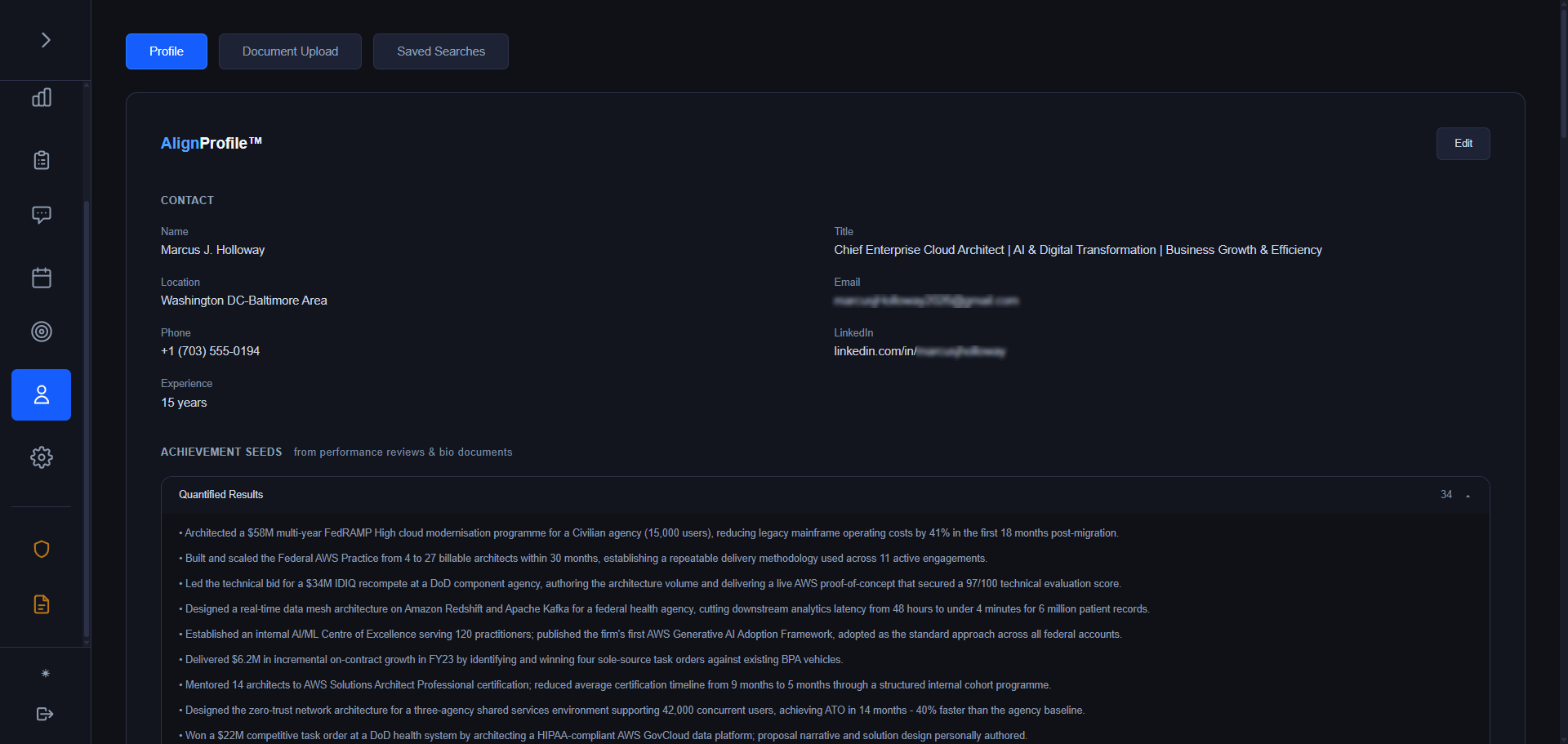
AlignProfile™ — a federal career translated into an achievement-first structured profile - AlignScore™ scores that profile against a specific private-sector job description across the same six dimensions of the Executive Fit Framework™ that a commercial hiring panel actually uses — so you see the translation gap before you apply, not after the silence.
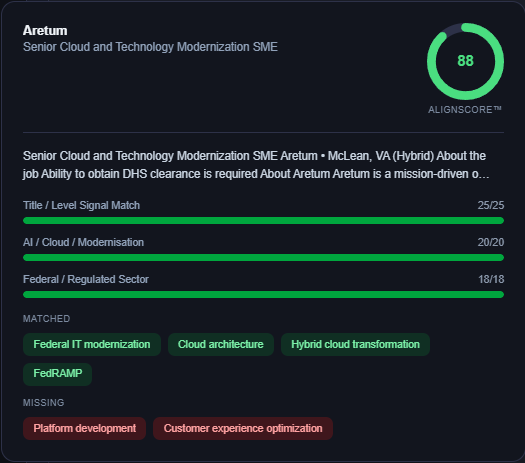
AlignScore™ — a dimension-by-dimension fit result against a specific private-sector JD, before you apply - AlignPath™ turns any genuine gap into a tracked plan — and every resume EmploiAlign generates is grounded strictly in your real experience. Your federal career, translated, never invented.
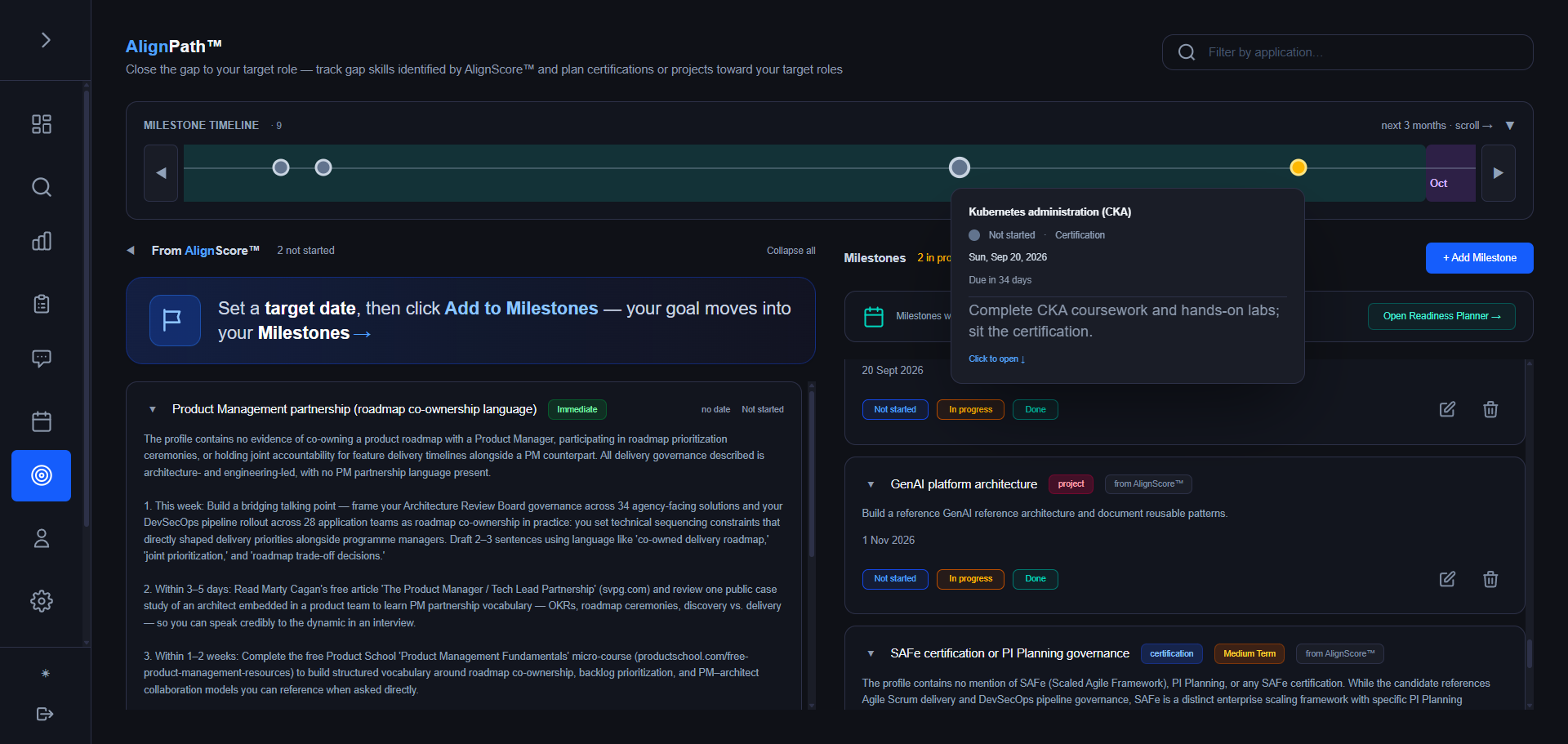
AlignPath™ — gaps identified by AlignScore™ become a tracked milestone plan with target dates, not a vague to-do list
The bottom line
Your federal career was real, and the scope was genuine. The gap is translation, not substance — and it's a closeable one.