 EmploiAlign™
Career Transition · Diagnostic Guide
5 Signs Your Resume Isn’t Working — Even Though You’re Overqualified
Being overqualified doesn’t guarantee being seen. Five specific signals that your resume is the problem — not your career.
You’re not underqualified. You’re over it — and you’re still not hearing back. You have the years, the scope, and the track record. Your background checks every box the job description asks for, often with room to spare. And yet the response, when there is one, is a form rejection. More often, it’s silence.
That contradiction is the clearest signal that something in the resume itself, not your career, is the problem. If you were genuinely unqualified, a low response rate would make sense. Being overqualified and invisible is a different failure mode entirely, and it’s a fixable one — once you know what to look for.
Research from Harvard Business School and Accenture on the “hidden workers” phenomenon found that candidates who are 80–90% qualified for a role are routinely filtered out of the applicant pool before a human ever reviews their application. This isn’t a judgment on your capability. It’s a structural filtering problem built into how modern hiring screens at scale — and it explains why decades of genuine experience can go completely unanswered.
The five signs
1. You meet every requirement and still hear nothing. Your resume isn’t showing the screener your fit — it’s assuming they’ll infer it. Meeting the bar on paper doesn’t help if nothing on the page makes the match obvious in the first few seconds of review.
2. People ask “what do you actually do?” after reading it. If a friend, a recruiter, or a former colleague can’t quickly place your role after reading your resume, neither can a scoring model or a busy hiring manager scanning a stack of applications.
3. Your biggest wins are buried in paragraph form. Quantified impact needs to be scannable in the first line of a bullet, not the third sentence of a dense block. If a reader has to work to find your best achievement, most won’t.
4. Every bullet reads like a duty, not an outcome. “Responsible for” language scores lower than “delivered,” “reduced,” or “grew” language on every dimension that measures impact. A list of responsibilities describes a job. A list of outcomes describes a leader.
5. The resume looks the same for every role you apply to. One resume cannot mirror the specific keyword language of ten different job descriptions. Both ATS matching and human panel scoring reward mirroring — a generic resume, however strong, reads as generic everywhere it’s sent.
Guidance
If two or more of these are true for you, the fix is rarely “write more.” It’s re-scoring and re-mirroring your resume against the specific role in front of you, rather than sending out one version and hoping it lands.
How EmploiAlign Helps
- Paste any job description into AlignScore™ and get an instant fit read across the six weighted dimensions of the Executive Fit Framework™ — so you know which of the five signs above is actually costing you points, before you guess.
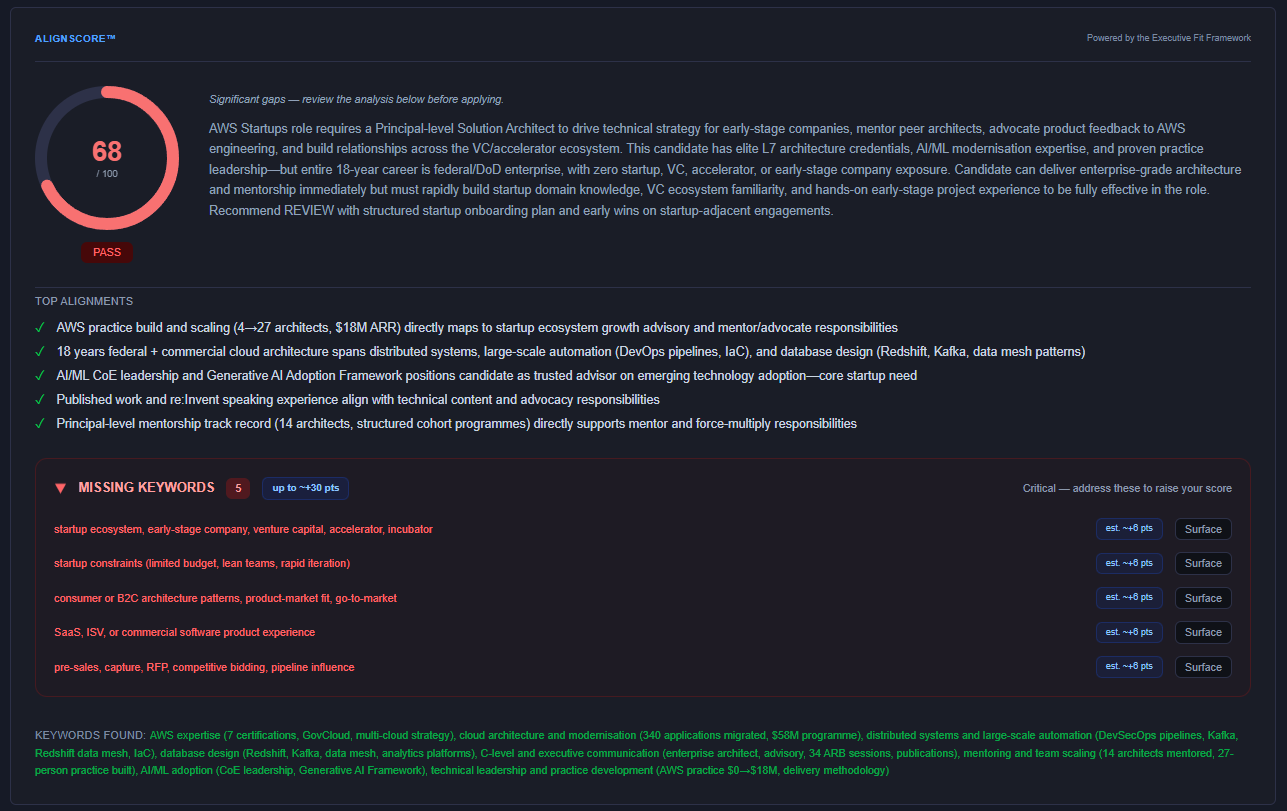
AlignScore™ — a 68 fit score with five flagged keyword gaps, each worth points you can recover before applying - AlignScore™ classifies every missing keyword as either “surfaceable” — already in your experience, just not visible on the page — or a genuine gap, so you’re not rewriting blind.
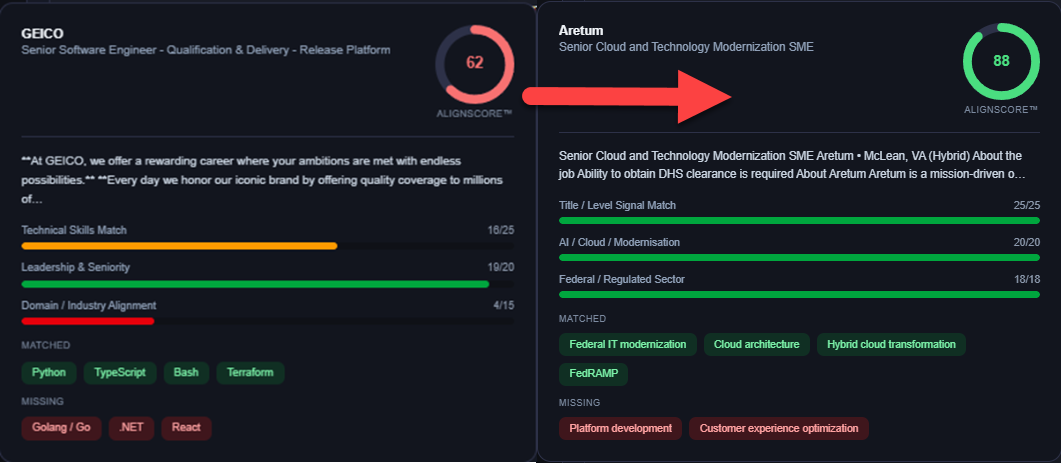
AlignBoard™ — the same profile scores 62 against a mismatched role and 88 against the right one; mirroring the JD’s language is the difference - When you’re ready, generate a resume mirrored to that specific job description’s language, grounded entirely in your real experience — nothing invented, nothing inflated.
Conclusion
Being overqualified and invisible isn’t a contradiction — it’s a scoring problem, and scoring problems are fixable once you can see the scorecard.