 EmploiAlign™
ATS & Hiring · Myth-Busting Guide
Fixing ATS Rejections: What Actually Gets a Senior Candidate Filtered
The “75% of resumes get rejected by ATS” statistic is fabricated. Here’s what actually filters senior candidates — and what to fix.
The “75% of resumes get rejected by an ATS” statistic is perhaps the most persistent and damaging myth in the modern job search. You have likely seen it cited in viral social media posts, career coaching advertisements, or “resume hack” videos that promise to help you beat the robot gatekeepers. For a senior professional or executive, this statistic creates a specific kind of anxiety: the fear that years of hard-won leadership and technical expertise are being deleted by an unthinking algorithm before a human ever sees them.
The truth is far less cinematic, but much more actionable: that 75% statistic is entirely fabricated. It traces back to a 2012 sales pitch from a now-defunct company called Preptel, which published no methodology and went bankrupt shortly after its “research” went viral. By believing your resume is being rejected by a secret AI algorithm, you are incentivized to solve the wrong problem — optimizing for a robot that doesn’t exist rather than a recruiter who is simply overwhelmed.
When you focus on “beating” the system with technical tricks or keyword stuffing, you neglect the substance of your application. The silence following your submission isn’t the sound of an algorithm at work; it is the sound of a high-volume process where the human element remains central, even if it is currently hidden behind a digital interface.
Current research into hiring pipelines reveals a much different reality than the “75% rejection” narrative suggests. In a 2025 study of 25 US-based recruiters across sectors like finance, technology, and healthcare, 92% confirmed that their Applicant Tracking Systems (ATS) do not automatically reject resumes based on content, match scores, or formatting. While these systems are used by 97.8% of Fortune 500 companies, they function as searchable databases — digital filing cabinets — rather than autonomous gatekeepers. The real barrier isn’t a secret score; it is the employer-set “knockout questions” and a massive supply-demand gap where 180 applicants compete for every single hire. Currently, 51% of resumes contain only about half of the relevant keywords found in the job description, meaning they simply fail to surface when a recruiter runs a search.
What’s actually happening
Knockout questions, not algorithms, gate most applications. The only legitimate form of automatic rejection in most systems comes from “knockout questions” configured by the employer during the initial application form. These questions address non-negotiable requirements — such as work authorization, specific required licenses, or minimum years of experience — and are answered by the candidate before the resume is even parsed by the software. If you answer “no” to a requirement the company has marked as mandatory, the system will move you to a “rejected” status regardless of how qualified your resume appears.
Volume, not software, explains most silence. We are currently in a high-volume hiring environment where application volume has climbed significantly while qualified applicant rates have declined. With an average of 180 to 257 applicants per role, recruiters are forced to triage submissions with extreme speed. Research indicates that a recruiter spends approximately 7.4 seconds on an initial scan to decide if a candidate is worth a deeper look. If a resume fails to make a compelling, qualified case within those first ten seconds, the recruiter moves on; the candidate is skipped by a human, not “rejected” by an algorithm.
Formatting failures are real, but narrow. While the ATS doesn’t “reject” for style, it can make a resume invisible if the formatting prevents successful parsing. Parsing failures occur when the software cannot extract your work history or skills into searchable fields. Standard tables cause a 31% parsing failure rate, while two-column layouts fail 14% of the time. When these failures happen, your resume still exists in the database, but you will not appear in a recruiter’s keyword search, rendering you effectively invisible.
The real fix checklist
- Single-column, standard section headers, no tables or text boxes. To ensure 96% to 99% parsing accuracy, use a clean DOCX or PDF file with a single-column layout. Use standard headings like “Work Experience” or “Skills” rather than creative alternatives like “My Journey,” which can confuse the parser and cause entire sections of your experience to vanish.
- Mirror the JD’s specific keyword language, not synonyms. Most ATS platforms do not recognize synonyms; they are looking for exact matches for the recruiter’s search terms. If a job description calls for “Strategic Planning,” ensure your resume uses that exact phrase rather than “long-term business mapping.”
- Front-load quantified impact so a 10-second human scan finds it immediately. Since the real gate is a busy human recruiter, your most impressive achievements must be “surfaceable” instantly. Use short, achievement-focused bullet points and include both the acronym and the full term for your credentials to ensure you appear in every possible search variation.
Guidance
- Fix the formatting once — it’s a one-time technical fix. Once your resume is in a single-column, standard-header format, you have cleared the technical hurdle.
- Spend your real effort on making the case fast. Because human review is the ultimate filter, the most critical task is ensuring your quantified impact is undeniable within a ten-second scan.
How EmploiAlign Helps
- Step 1: When EmploiAlign generates a resume from your AlignProfile™, it’s single-column, table-free, and keyword-mirrored to the specific JD by construction — the formatting fix is built in, not something you have to remember.
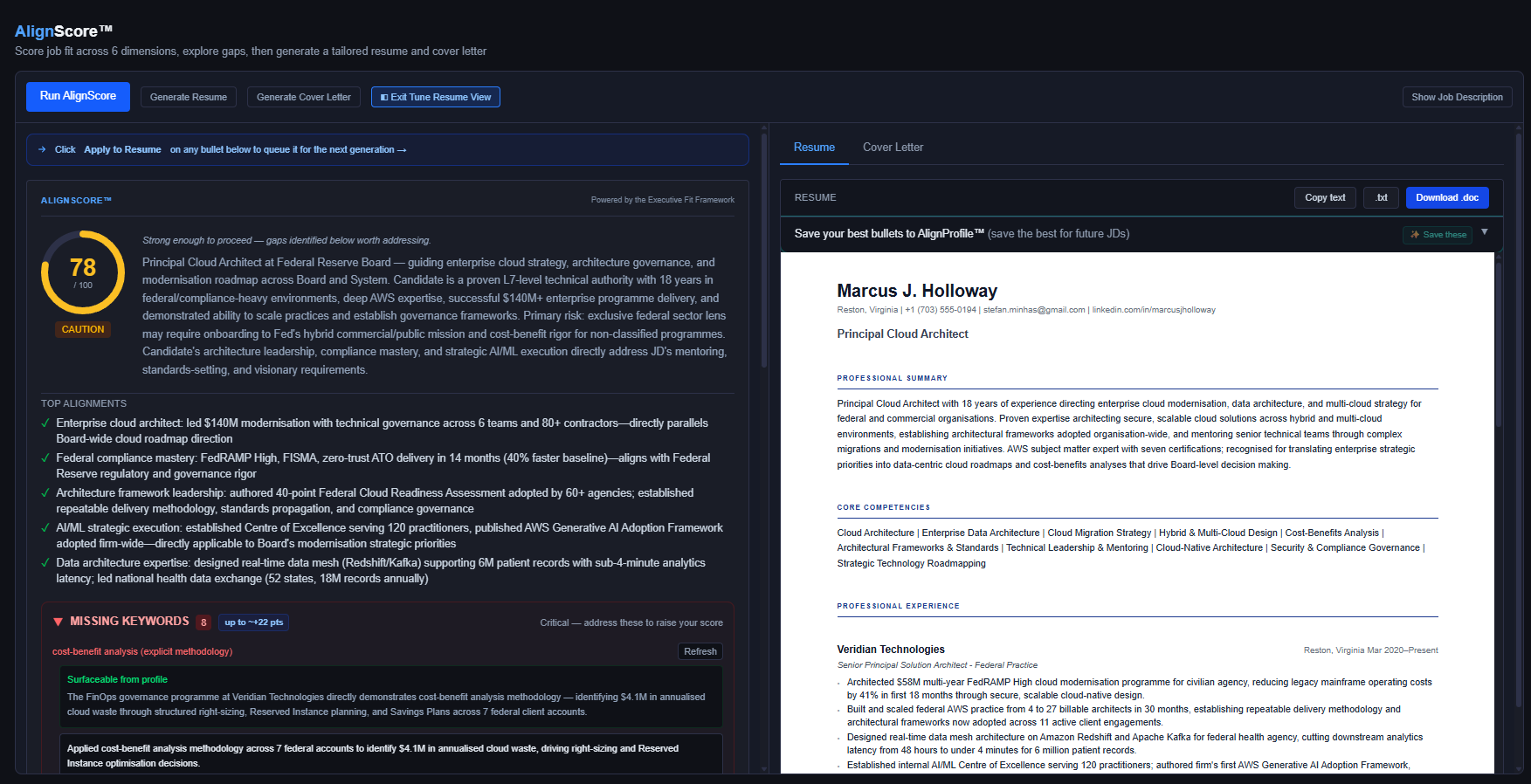
AlignScore™ + generated resume — keyword-mirrored, single-column, and ATS-compliant by construction; surfaceable gaps surfaced before you apply - Step 2: AlignScore™ provides you with a realistic fit score before you submit your application, allowing you to move beyond the fear that an ATS “ate” your resume. It scores your profile across six weighted dimensions of the Executive Fit Framework™, giving you clear visibility into your actual standing.
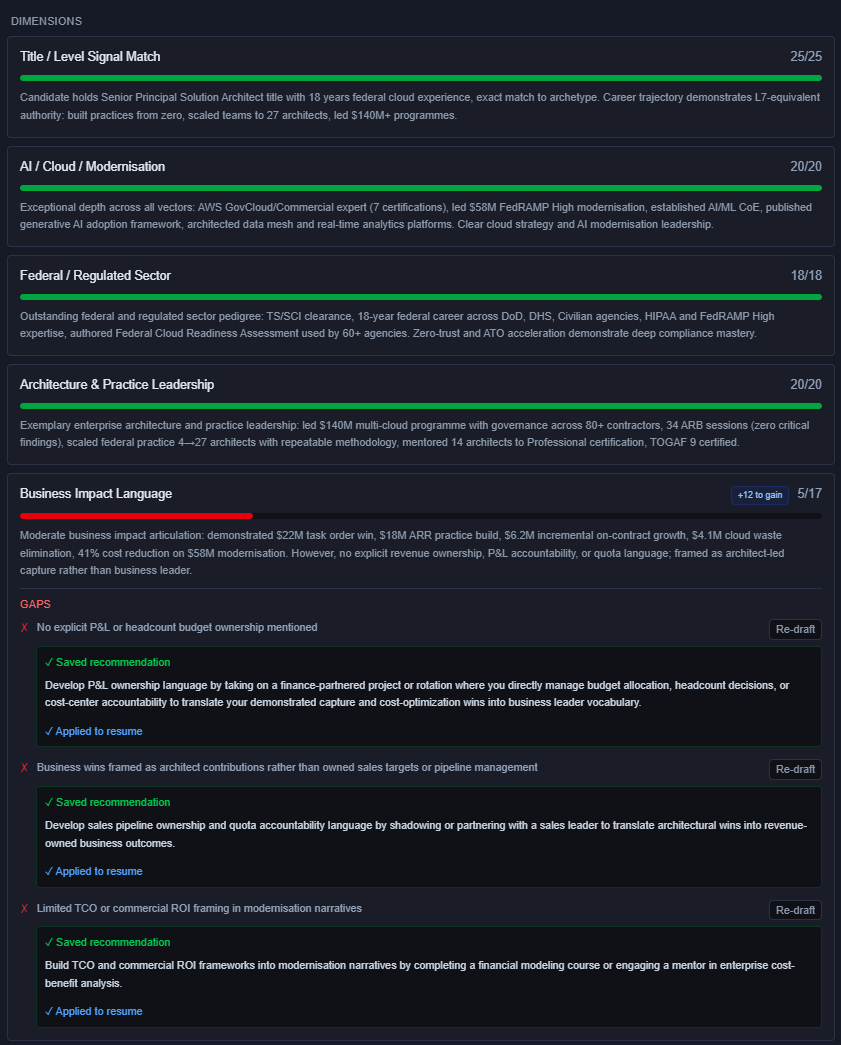
AlignScore™ six-dimension view — four dimensions fully matched, one (Business Impact Language) flagged with specific gaps and actionable development recommendations - Step 3: If the scoring analysis reveals a genuine experience gap rather than a simple formatting error, AlignPath™ turns that gap into a structured development plan. This allows you to focus on the real bottlenecks in your career transition — such as missing specific senior-level competencies — rather than chasing the myth of an automated rejection algorithm.
Conclusion
The ATS is not a black box designed to eat qualified resumes; it is simply a formatting and matching layer positioned in front of an overwhelmed human recruiter. By fixing your technical formatting, mirroring the specific language of the role, and leading with quantified impact, you ensure that your senior-level expertise remains visible where it matters most.